Trust Written in Pencil: In Defence of the Village Tab
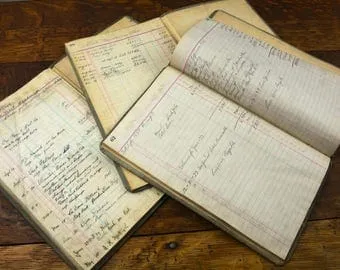
Photo: vintage shop ledger book with handwritten accounts on wooden counter, via img1.etsystatic.com
There is a particular kind of silence in a card-only shop. The transaction completes, the machine beeps, and neither party has needed to know a single thing about the other. It is efficient. It is also, in our view, a small and steady erosion of what a shop is actually for.
At Brookshaws & Sons, we still run a tab for a number of our regulars. Not many, by modern standards. A few dozen households, a couple of the neighbouring farms, the golf club when the Christmas order comes in. There is no app, no credit check, no interest charged. There is a page in a book, a name at the top, and a relationship that in most cases predates the current manager of the bank up the road.
What the Old Ledgers Actually Record
People imagine the old credit books were simply lists of debts. They were not, or not only. Ours, going back to the 1920s, record patterns of life. You can see the winter when a family's entries stop and a note in the margin says paid in spring, hard year. You can see the widow who settled her account every quarter to the penny, and the young couple who ran six weeks behind for two years and never missed a month after. The ledger is not a record of what people owed. It is a record of what they were like.
That, more than anything, is the argument for the tab. A tab is a mutual assessment, renewed continuously. The shop extends it because it has watched someone keep their word for years. The customer accepts it because they intend to honour it, and both parties understand that the arrangement is only as strong as that intention. It is a handshake renewed weekly, in pencil, over the counter.
Why Card-Only Businesses Are Poorer for It
The modern counter-argument is obvious: cash flow, compliance, fairness. We do not dismiss it. But consider what has been traded away. A card-only business cannot distinguish between a customer of thirty years and a stranger who walked in off the street five minutes ago. The till treats them identically, which sounds like equality and is in fact indifference.
When we let a regular settle at the end of the month, we are telling them something: that we know them, that we have noticed, that their word is good here. When they pay, they tell us the same thing back. Strip that out and you are left with a vending machine the size of a shop.
There is a practical benefit too, though it is the lesser one. A tab keeps money in the town. When the harvest is late or the factory shifts are reduced, our customers are not forced to choose between the supermarket's offer and going without. They wait a fortnight, they settle up, and the local economy keeps its pulse. Card-only operations, answerable to no one locally, cannot make that accommodation and so cannot keep that custom.
The Rules We Keep, Quietly
Lest this sound like nostalgia unmoored from sense, our tab operates under rules as old as the practice itself. It is offered, never requested. It is limited to a sum we could comfortably write off. It is reviewed whenever a name sits too long without movement. And it is withdrawn, gently but firmly, when trust is breached — which, in five generations, has happened rarely enough that we remember every occasion.
The point is that the tab is not generosity. It is underwriting of a very traditional kind, based on evidence gathered the slow way: by seeing someone every week for a decade.
An Argument for Friction
We accept that most of the high street will not follow us, and that the contactless era is not going to be argued out of existence by a grocer's opinion piece. But we would ask readers to notice what disappears when every transaction is anonymous. Communities are not built by efficiency. They are built by small, repeated acts of trust — the sort that never show up on a statement.
The pencil in our ledger is worn down to a stub, and we sharpen it ourselves. We intend to keep doing so.
Do you remember running a tab, here or elsewhere? We would be glad to hear the story — ask at the counter, or write to us at the shop.