Twelve by Fourteen: A Defence of the Units Our Customers Actually Think In
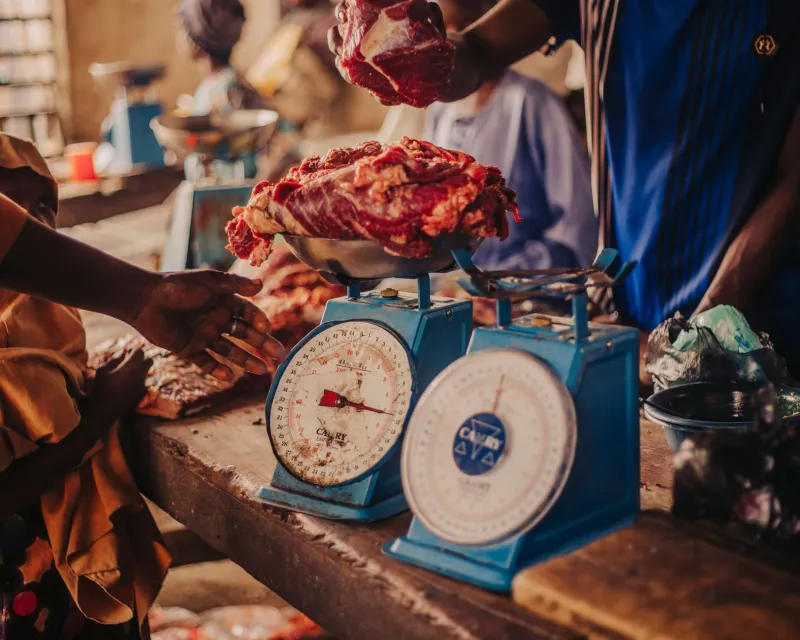
There is a moment that happens most weeks at our counter, and it goes something like this. A customer, often younger than the shop itself, will pause, glance at the digital display, and then ask — almost apologetically — whether we might do them 'a pound of the best back bacon, if that's all right.' It is always all right. It has been all right since 1892.
We are often asked, gently or otherwise, why a firm of our standing insists on such old-fashioned habits. The scales above the counter are dual-marked, of course; we are not in the business of breaking the law. But the pound is what we quote, the foot is what we measure in the window cards, and the yardstick — quite literally — is what hangs behind the bacon slicer. This is not stubbornness for its own sake. It is a considered position, and we shall set it out here.
Weights That Carry Weight
A kilogram is a unit. A pound is a memory. When Mrs Hartley asks for two pounds of sausages for the family coming Sunday, she is not performing arithmetic — she is recalling her mother's order, and her mother's before that. The number sits in the same part of the mind that holds hymn numbers and telephone digits learned in childhood. Convert it to 907 grams and something essential is lost: the continuity of the request itself.
There is a practical argument too. A pound divides. Half of it, a quarter of it — these are things a human hand can judge. Nobody ever asked for 0.227 of anything, and nobody ever will.
The Rooms People Actually Picture
The same reasoning governs our estate agency window, though we concede it is a stranger sight there. Every other card in every other agent's window in the district speaks in square metres. Ours speak in feet, and we intend them to go on doing so.
The reason is simple: house-hunters do not think in square metres, whatever the paperwork says. Stand at the door of a bedroom with a prospective buyer and listen to what they say. 'About twelve by fourteen, would you say?' Never 'three point six by four point two'. The foot is the unit in which the British imagination furnishes a room — it knows where the double bed goes and whether the wardrobe will block the window at twelve by fourteen, and it has no such instincts in metric.
A house is not bought on paper. It is bought by a person standing in a room, measuring it against every room they have ever known. We would rather our cards spoke the language of that interior monologue than the language of a directive.
Precision Is Not the Same as Truth
The case for metric rests on precision, and we do not dismiss it. Precision matters in engineering, in medicine, in trade across borders. But precision is not the same as trust, and trust is our trade. When a customer hears 'a pound of best back bacon' cut to the pound as their grandfather understood it, they are receiving not merely meat but a promise — that the measure they were taught is still honoured here.
There is a story we tell against ourselves. Some years ago a young relative, full of college learning, reprinted our price cards in kilograms and metres only. Trade did not stop, but it slowed perceptibly; customers hesitated, asked one another, ordered cautiously. Within a fortnight the old cards were back in the window, and the young man — now a director, we should say — concedes the lesson freely. The customers did not want new numbers. They wanted their numbers.
Not Nostalgia, But Sense
We are aware this can be painted as sentiment, and we accept the charge with equanimity. A family firm that has served one town for five generations is entitled to a little sentiment. But the truer description is practical: we use the measures our customers use because a business that makes its customers translate is a business that has begun to put itself first.
So the pound remains on the counter, the feet remain in the window, and the yardstick hangs where it has always hung. When the last customer who thinks in pounds and feet has gone — and we suspect that day is further off than the reformers imagine — we shall reconsider. Until then, a pound of best back bacon it is, cut generous, as ever it was.